
Keyword
Research Voyage: IN2015_V01
24 record(s)
Type of resources
Topics
Keywords
Contact for the resource
Provided by
Formats
Update frequencies
Status
draft
-
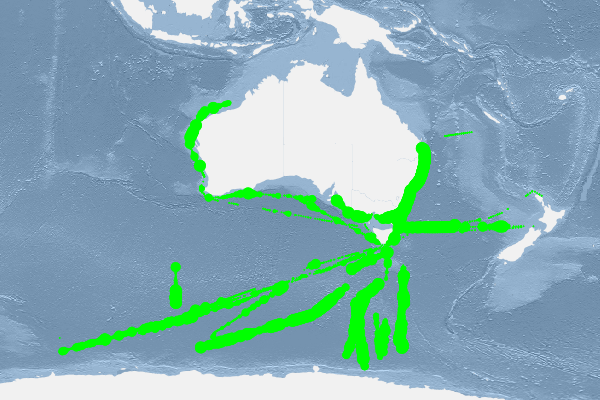
AusCPR: Phytoplankton Abundance. The Australian Continuous Plankton Recorder (AusCPR) survey is a joint project between CSIRO Oceans and Atmosphere (O&A) and the Australian Antarctic Division (AAD) to measure plankton communities as a guide to the health of Australia's oceans. The phytoplankton abundance data are analysed as per Richardson et al 2006. Phytoplankton are usually counted from water samples after settling but in the CPR analysis we count the phytoplankton in situ. With CPR samples, the phytoplankton is captured by the mesh and are caught by the silk strands, by phytoplankton mucilage, and/or by other organisms on the silk. It is thus possible to see the phytoplankton cells directly on the mesh. In essence, the phytoplankton is already concentrated. Washing the phytoplankton off the silks to count in the standard manner may result in loss of or damage to cells before analysis. It is advised that anyone using the data should first read this methodology or contact the project contact person. The aims of the AusCPR survey are to: * map plankton biodiversity and distribution * develop the first long-term plankton baseline for Australian waters * document plankton changes in response to climate change * provide indices for fisheries management * detect harmful algal blooms * validate satellite remote sensing * initialise and test ecosystem models. Servicing and maintenance of the CPRs and analysis of the samples for the AusCPR survey will be carried out by staff based at the O&A laboratories in Queensland and at the AAD in Hobart. The project was funded by the Integrated Marine Observing System (IMOS) and falls with the Ships of Opportunity facility. Data storage and access is planned to be interoperable with other national and international programs through the IMOS Infrastructure. Results from the AusCPR survey are available through the AODN portal: https://portal.aodn.org.au. For information on using the data please refer to the Richardson et al. 2006. As the taxonomic resolution of the data has changed over time, due to continual training, it is important that users refer to the change log tables included in your data download. These will provide information on the validity of the taxa, from what date we have been identifying certain taxa etc. Classification fields may be blank depending on the level to which that taxa has been identified, i.e. if only identified to family, genus and species will be blank. This data is freely available but please acknowledge all relevant parties, as detailed in acknowledgement section.
-
This record describes data from the ATR-FTIR and Raman spectrometers collected on the Marine National Facility RV Investigator voyage IN2015_V01. This was a trial voyage for the RV Investigator departing Hobart on the 21st March and returning to Hobart on the 29th March, 2015. The PerkinElmer Spectrum 2 Attenuated Total Reflectance Fourier Transform Infrared (ATR-FTIR)Spectrometer (serial # 99683) on loan from PerkinElmer Australia. The instrument acquires infrared spectra of thin samples such as phytoplankton deposits on filters. FTIR spectra: 144 spectra from 48 samples from 6 sites Calibration of the PerkinElmer instrument performed by the company prior to the voyage. The BaySpec Agility Raman spectrometer with 1064 nm excitation laser and fibre probe optics (serial # P1480093) owned by Monash University. The instrument acquires Raman spectra of phytoplankton deposits. Raman spectra: 72 spectra from 12 samples from 2 sites Calibration of the Monash University instrument last performed 26 February 2015.
-
This record describes echosounder data collected on the Marine National Facility RV Investigator voyage IN2015_V01. This is the first research voyage for the RV Investigator departing Hobart on the 21 March and returning to Hobart on the 30 March, 2015. Ping rate varied according to depth. Data are stored in *.all raw format at CSIRO Oceans and Atmosphere. There are 145 files totalling 3.69 GB of raw data in this dataset. GSF files of the data are also available. Sound velocity profiles were applied to this data during data acquisition. Tide corrections were not applied to the processed data. Additional information regarding this dataset is contained in the GSM data acquisition and processing report. Additional data products available on request.
-
This record describes multibeam echosounder data collected on the Marine National Facility RV Investigator voyage IN2015_V01. This is the first research voyage for the RV Investigator departing Hobart on the 21 March and returning to Hobart on the 30 March, 2015. The Kongsberg EM710 multibeam echosounder was used to acquire seafloor bathymetry and backscatter information when in water less than 1000 m. Ping rate varied according to depth. Data are stored in *.all raw format at CSIRO Oceans and Atmosphere. There are 19 files totaling 3.48 GB of raw data in this dataset. Sound velocity profiles were applied to this data during data acquisition. Tide corrections were not applied to the processed data. Additional information regarding this dataset is contained in the GSM data acquisition and processing report. Additional data products available on request.
-
This record describes echosounder data collected on the Marine National Facility RV Investigator voyage IN2015_V01. This is the first research voyage for the RV Investigator departing Hobart on the 21 March and returning to Hobart on the 30 March, 2015. The Simrad EK60 split beam echosounders, 38, 70, 120, 200 and 333 KHz were used to acquire water column and bathymetry data. Data are stored in *.raw *.bot and *.idx format at CSIRO Oceans and Atmosphere. There are 747 files totalling 15.9 GB of raw data in this dataset. Additional information regarding this dataset is contained in the GSM data acquisition and processing report.
-
This record describes sub bottom data collected on the Marine National Facility RV Investigator voyage IN2015_V01. This is the first research voyage for the RV Investigator departing Hobart on the 21 March and returning to Hobart on the 30 March, 2015. The Kongsberg SBP120 (Sub bottom profiler) was used to acquire data south west of Tasmania. Data are stored in *.raw raw and *.seg segy formats at CSIRO Oceans and Atmosphere. There are 53 files totaling 3.08 GB of raw data in this dataset. Additional information regarding this dataset is contained in the GSM data acquisition and processing report.
-
This record describes echosounder data collected on the Marine National Facility RV Investigator voyage IN2015_V01. This is the first research voyage for the RV Investigator departing Hobart on the 21 March and returning to Hobart on the 30 March, 2015. Data are stored in Simrad *.raw raw format at CSIRO Oceans and Atmosphere. There are 28 files totaling 26.3 GB of raw data in this dataset. Additional information regarding this dataset is contained in the GSM data acquisition and processing report.
-
This record describes the Acoustic Doppler Current Profiler (ADCP) data collected from the Marine National Facility RV Investigator voyage: IN2015_V01 titled "IMOS Southern Ocean Time Series Automated Moorings for Climate and Carbon Cycle Studies Southwest of Tasmania". This was the first research voyage for the RV Investigator. The voyage took place between the 21st and the 30th of March, 2015 departing from Hobart and sailing to the south-west of Tasmania (47 S, 142 E) and returning to Hobart. This dataset was processed and then archived within the CSIRO Oceans and Atmosphere (O&A) Information and Data Centre (IDC) in Hobart.
-
This record describes data from the BASTA cloud radar, collected on the Marine National Facility RV Investigator voyage IN2015_V01. This voyage departed Hobart on the 21st March and returned to Hobart on the 29th of March, 2015. The BASTA cloud radar is a vertically-pointing 95 GHz FM-CW (Frequency Modulation - Continuous Wave) radar. It measures vertical profiles of radar reflectivity (approximately proportional to the cloud particle diameter to the 4th power), and Doppler velocity (sum of vertical wind speed and terminal fall velocity of cloud particles when pointing vertically) at 1.5s temporal resolution, and four different vertical resolutions (12.5, 25, 100 and 200m) up to 12 km height. Currently the instrument is not mounted on a stabilized platform but will be in a near future. This cloud radar is owned by the Australian Bureau of Meteorology. It was developed by the Laboratoire ATmosphere, Milieux et Observations Spatiales (LATMOS) in France. It is serial number 2. Calibration of the cloud radar was performed in 2014 using fixed targets of known reflectivity, and reflectivity in light rain.
-
This record describes data from the Benchtop PAM fluorometer owned by UTS, collected on the Marine National Facility RV Investigator voyage IN2015_V01. This was a voyage for the RV Investigator departing Hobart on the 21st March and returning to Hobart on the 29th March, 2015. Number of samples: 35 Number of stations: 7 -during triaxis tows.